ASTM D1135-86(2020)

Current Revision
Standard Test Methods for Chemical Analysis of Blue Pigments

Best Price Guarantee Jun 1, 2020 English 6 Pages

Sub Total (1 Item(s)) $ 0.00
Estimated Shipping $ 0.00
Total (Pre-Tax) $ 0.00

You own the digital copy of this edition

View in Library
or
ASTM D1135-86(2020) PDF Preview
ASTM D1135-86(2020)

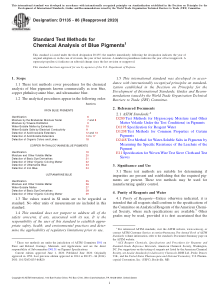
1.1 These test methods cover procedures for the chemical analysis of blue pigments known commercially as iron blue, copper phthalocyanine blue, and ultramarine blue.

1.2 The analytical procedures appear in the following order:

  • IRON BLUE PIGMENTS
    • Identification — Sections 6
    • Moisture by the Brabender Moisture Tester — Sections 7 and 8
    • Moisture by Toluene Distillation — Section 9
    • Water-Soluble Matter by Extraction — Section 10
    • Water-Soluble Salts by Electrical Conductivity — Section 11
    • Detection of Acid-Insoluble Extenders — Sections 12 and 13
    • Detection of Acid-Soluble Extenders — Sections 14 to 17
    • Detection of Organic Colors and Lakes — Section 18
  • COPPER PHTHALOCYANINE BLUE PIGMENTS
    • Identification — Section 19
    • Moisture and Other Volatile Matter — Section 20
    • Detection of Basic Dye Derivatives — Section 21
    • Detection of Other Organic Coloring Matter — Section 22
    • Detection of Ultramarine Blue — Section 23
    • Detection of Iron Blue — Section 24
  • ULTRAMARINE BLUE
    • Identification — Section 25
    • Moisture and Other Volatile Matter — Section 26
    • Water-Soluble Matter — Section 27
    • Detection of Basic Dye Derivatives — Section 28
    • Detection of Other Organic Coloring Matter — Section 29

1.3 The values stated in SI units are to be regarded as standard. No other units of measurement are included in this standard.

1.4 This standard does not purport to address all of the safety concerns, if any, associated with its use. It is the responsibility of the user of this standard to establish appropriate safety, health, and environmental practices and determine the applicability of regulatory limitations prior to use.

1.5 This international standard was developed in accordance with internationally recognized principles on standardization established in the Decision on Principles for the Development of International Standards, Guides and Recommendations issued by the World Trade Organization Technical Barriers to Trade (TBT) Committee.

1.1 These test methods cover procedures for the chemical analysis of blue pigments known commercially as iron blue, copper phthalocyanine blue, and ultramarine blue.

1.2 The analytical procedures appear in the following order:

  • IRON BLUE PIGMENTS
    • Identification (Sections 6)
    • Moisture by the Brabender Moisture Tester (Sections 7 and 8)
    • Moisture by Toluene Distillation (Section 9)
    • Water-Soluble Matter by Extraction (Section 10)
    • Water-Soluble Salts by Electrical Conductivity (Section 11)
    • Detection of Acid-Insoluble Extenders (Sections 12 and 13)
    • Detection of Acid-Soluble Extenders (Sections 14 to 17)
    • Detection of Organic Colors and Lakes (Section 18)
  • COPPER PHTHALOCYANINE BLUE PIGMENTS
    • Identification (Section 19)
    • Moisture and Other Volatile Matter (Section 20)
    • Detection of Basic Dye Derivatives (Section 21)
    • Detection of Other Organic Coloring Matter (Section 22)
    • Detection of Ultramarine Blue (Section 23)
    • Detection of Iron Blue (Section 24)
  • ULTRAMARINE BLUE
    • Identification (Section 25)
    • Moisture and Other Volatile Matter (Section 26)
    • Water-Soluble Matter (Section 27)
    • Detection of Basic Dye Derivatives (Section 28)
    • Detection of Other Organic Coloring Matter (Section 29)

1.3 The values stated in SI units are to be regarded as standard. No other units of measurement are included in this standard.

1.4 This standard does not purport to address all of the safety concerns, if any, associated with its use. It is the responsibility of the user of this standard to establish appropriate safety, health, and environmental practices and determine the applicability of regulatory limitations prior to use.

1.5 This international standard was developed in accordance with internationally recognized principles on standardization established in the Decision on Principles for the Development of International Standards, Guides and Recommendations issued by the World Trade Organization Technical Barriers to Trade (TBT) Committee.

3.1 These test methods are suitable for determining if impurities are present and establishing that the required pigments are present.

These test methods may be used for manufacturing quality control.

Loading...

Failed to load document history.

Publish Date Document Id Type View