+1 888 608-7511
Need help finding a standard?
Help Desk
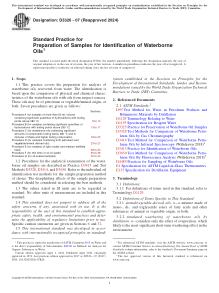
1.1 This practice covers the preparation for analysis of waterborne oils recovered from water. The identification is based upon the comparison of physical and chemical characteristics of the waterborne oils with oils from suspect sources. These oils may be of petroleum or vegetable/animal origin, or both.
Seven procedures are given as follows:
1.2 Procedures for the analytical examination of the waterborne oil samples are described in Practice D3415 and Test Methods D3328, D3414, and D3650. Refer to the individual oil identification test methods for the sample preparation method of choice. The deasphalting effects of the sample preparation method should be considered in selecting the best methods.
1.3 The values stated in SI units are to be regarded as standard. No other units of measurement are included in this standard.
1.4 This standard does not purport to address all of the safety concerns, if any, associated with its use. It is the responsibility of the user of this standard to establish appropriate safety, health, and environmental practices and determine the applicability of regulatory limitations prior to use. Specific caution statements are given in Sections 6 and 32.
1.5 This international standard was developed in accordance with internationally recognized principles on standardization established in the Decision on Principles for the Development of International Standards, Guides and Recommendations issued by the World Trade Organization Technical Barriers to Trade (TBT) Committee.
1.1 This practice covers the preparation for analysis of waterborne oils recovered from water. The identification is based upon the comparison of physical and chemical characteristics of the waterborne oils with oils from suspect sources.
These oils may be of petroleum or vegetable/animal origin, or both. Seven procedures are given as follows:
1.2 Procedures for the analytical examination of the waterborne oil samples are described in Practice D3415 and Test Methods D3328, D3414, and D3650. Refer to the individual oil identification test methods for the sample preparation method of choice.
The deasphalting effects of the sample preparation method should be considered in selecting the best methods.
1.3 The values stated in SI units are to be regarded as standard. No other units of measurement are included in this standard.
1.4 This standard does not purport to address all of the safety concerns, if any, associated with its use. It is the responsibility of the user of this standard to establish appropriate safety, health, and environmental practices and determine the applicability of regulatory limitations prior to use.
Specific caution statements are given in Sections 6 and 32.
1.5 This international standard was developed in accordance with internationally recognized principles on standardization established in the Decision on Principles for the Development of International Standards, Guides and Recommendations issued by the World Trade Organization Technical Barriers to Trade (TBT) Committee.
4.1 Identification of a recovered oil is determined by comparison with known oils selected because of their possible relationship to the particular recovered oil, for example, suspected or questioned sources.
Thus, samples of such known oils must be collected and submitted along with the unknown for analysis.
It is unlikely that identification of the sources of an unknown oil by itself can be made without direct matching, that is, solely with a library of analyses.
Failed to load document history.
| Publish Date | Document Id | Type | View |
|---|