+1 888 608-7511
Need help finding a standard?
Help Desk
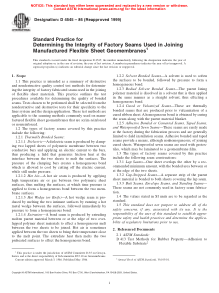
1.1 This practice is intended as a summary of destructive and nondestructive quality control test methods for determining the integrity of factory fabricated seams used in the joining of flexible sheet materials. This practice outlines the test procedures available for determining the quality of bonded seams. Tests chosen to be performed shall be selected from the nondestructive and destructive tests for their specificity to the liner system and the design application. These test methods are applicable to the seaming methods commonly used on manufactured flexible sheet geomembranes that are scrim-reinforced or nonreinforced.
1.2 The types of factory seams covered by this practice include the following:
1.2.1 Thermally Bonded Seams:
1.2.2 Solvent Bonded Seams - A solvent is used to soften the surfaces to be bonded, followed by pressure to form a homogeneous bond.
1.2.3 Bodied Solvent Bonded Seams - The parent lining polymer material is dissolved in a solvent that is then applied in the same manner as a straight solvent, thus effecting a homogeneous bond.
1.2.4 Cured or Vulcanized Seams - These are thermally bonded seams that are produced prior to vulcanization of a cured ribbon sheet. A homogeneous bond is obtained by curing the seam along with the parent material blanket.
1.2.5 Adhesive Bonded or Cemented Seams, Taped Seams, and Waterproofed Sewn Seams - These seams are rarely made at the factory during the fabrication process and are generally limited to field installation seams. Adhesive bonded and taped seams provide a means, although non-homogeneous, of joining cured sheets. Waterproofed sewn seams are used with geotextiles, which may be laminated to a geomembrane film.
1.3 The types of factory seams covered by this practice include the following seam constructions:
1.3.1 Lap Seams - One sheet overlaps the other by a recommended minimum amount, with the bonded area between or at the edge of the two sheets.
1.3.2 Cap-Stripped Seams - A separate strip of the parent sheet material is bonded to both sheets covering the lap seam.
1.3.3 Butt Seams, Envelope Seams, and Standing Seams - These seams are not commonly used in factory seam fabrication.
1.4 The values stated in SI units are to be regarded as the standard.
1.5 This standard may involve hazardous materials, operations, and equipment. This standard does not purport to address all of the safety problems associated with its use. It is the responsibility of whoever uses this standard to consult and establish appropriate safety and health practices and determine the applicability of regulatory limitations prior to use.
1.1 This practice is intended as a summary of destructive and nondestructive quality control test methods for determining the integrity of factory fabricated seams used in the joining of flexible sheet materials. This practice outlines the test procedures available for determining the quality of bonded seams. Tests chosen to be performed shall be selected from the nondestructive and destructive tests for their specificity to the liner system and the design application. These test methods are applicable to the seaming methods commonly used on manufactured flexible sheet geomembranes that are scrim-reinforced or nonreinforced.
1.2 The types of factory seams covered by this practice include the following:
1.3 The types of factory seams covered by this practice include the following seam constructions:
1.4 The values stated in SI units are to be regarded as the standard.
1.5 This standard may involve hazardous materials, operations, and equipment. This standard does not purport to address all of the safety problems associated with its use. It is the responsibility of whoever uses this standard to consult and establish appropriate safety and health practices and determine the applicability of regulatory limitations prior to use.
The increased use of geomembranes as barrier materials to restrict liquid migration from one location to another in soil and rock, and the large number of seam methods and types used in joining these geomembrane sheets, has created a need for standard tests by which the various seams can be compared and the quality of the seam systems can be evaluated.
This practice is intended to meet such a need.
Failed to load document history.
| Publish Date | Document Id | Type | View |
|---|