Logo
Login Sign Up
Current Revision

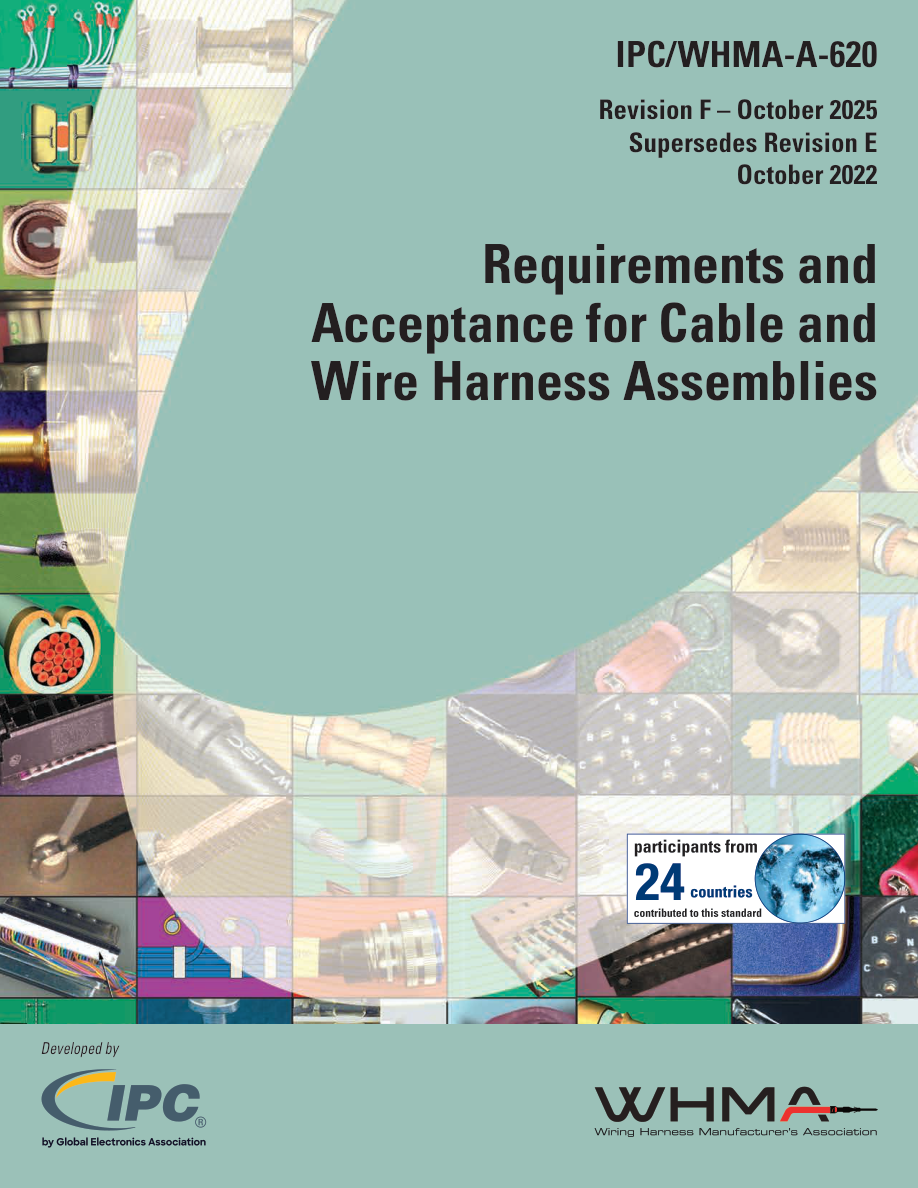
IPC/WHMA-A-620F

Requirements and Acceptance for Cable and Wire Harness Assemblies
Best Price Guarantee
Instant

$329.00

5-10 Days

$413.00

SAVE 10%

$667.80


Sub Total (1 Item(s))

$ 0.00

Estimated Shipping

$ 0.00

Total (Pre-Tax)

$ 0.00


View in Library
or

IPC/WHMA-A-620 is the globally recognized, industry-consensus standard that specifies requirements and acceptance criteria for cable and wire harness assemblies. Its purpose is to provide a common language and set quality benchmarks to ensure consistency, reliability, and clear communication between manufacturers and customers across various industries.

Purpose of IPC/WHMA-A-620

The primary purpose of the standard is to establish universal guidelines for the manufacturing and inspection of cable and wire harness products. Key objectives include:

  • Standardized Quality: Defining what constitutes acceptable and unacceptable workmanship for cable and wire assemblies to promote uniform quality globally.
  • Common Language: Creating a shared terminology and visual criteria (through detailed graphics) that reduces misunderstandings between original equipment manufacturers (OEMs), suppliers, and quality inspectors.
  • Enhanced Reliability: Providing criteria and best practices for materials, methods, and testing that help ensure products perform as expected and have a consistent, reliable lifespan.
  • Compliance and Trust: Facilitating regulatory compliance and building customer confidence by demonstrating a commitment to an internationally recognized quality standard, which is often a prerequisite for high-reliability industries.
How IPC/WHMA-A-620 Is Used

The standard is used as a comprehensive reference manual for personnel involved in the design, manufacture, use, and installation of cable/wire harness assemblies. Its application involves:

  • Determining Acceptance Criteria: Manufacturing and quality control personnel use the standard's detailed descriptions and visual examples to assess if products meet quality requirements (either passing as acceptable or failing as a reject).
  • Process Control: Manufacturers implement the standard's guidelines for process control methodologies to ensure consistent quality levels during production, reducing errors and the need for rework.
  • Training and Certification: Companies use the IPC/WHMA-A-620 as the basis for training and certifying their employees (operators, inspectors, and trainers), ensuring that the workforce possesses the accurate skills and knowledge of industry best practices.
  • Product Classification: The standard classifies assemblies into three classes based on their intended application and required reliability level:
    • Class 1 – General Products: For consumer items where basic function is sufficient (e.g., toys, simple electronics).
    • Class 2 – Dedicated Service Products: For products requiring extended performance and longer life, where uninterrupted service is desired but not critical (e.g., computers, communication devices).
    • Class 3 – High-Performance Products: For critical-use equipment in harsh environments where performance-on-demand is essential and downtime cannot be tolerated (e.g., medical life support systems, aerospace and military applications).
  • Industry Application: Engineers and sourcing managers in various sectors, including automotive, aerospace, medical, and industrial automation, rely on this standard to define quality expectations for their suppliers and products.
SDO IPC: IPC by Global Electronics Association
Document Number
Publication Date Oct. 1, 2025
Language en - English
Page Count 326
Revision Level
Supercedes
Committee
Loading...

Failed to load document history.

Publish Date Document Id Type View